
Learning and Wellbeing
Explore our holistic educational approach, engaging curriculum, and supportive learning environment.
Academic Excellence at Camberwell Primary School
Ranked #3 in Victoria — Top 10 Nationally
Camberwell Primary School is ranked the #3 public primary school in Victoria and among the top 10 nationally. We also measure success through the holistic development of each child—our academic outcomes reflect sustained excellence alongside our focus on wellbeing and inclusion.
Our students and programs have received recognition for excellence:
- Ranked #3 public primary school in Victoria
- Top 10 public primary school nationally
- Consistent NAPLAN performance above state average
- Strong VCE results from former students
- Recognition in academic competitions

Our unique immersion model seamlessly integrates French into the daily curriculum, ensuring students develop deep proficiency and academic success in both languages. Key features include:
- Authentic immersion: Mathematics and Science are taught only in the target language.
- Early Immersion: students commence their bilingual journey from their first day at school where an 80:20 model ensures they have an easy entrée into learning in the target language. From Year 2, students learn in a 50:50 model.
- French language instruction : CPS has developed our own French Curriculum to ensure targeted instruction at point of need on a developmental framework.
- Real-World Application: Opportunities for students to use French in authentic contexts, including partnerships and cultural events.

At l'école primaire de Camberwell / Camberwell Primary School, we believe in a holistic approach to education that nurtures the intellectual, social, emotional, and physical development of each child. Our philosophy is centred on:
- Fostering a love of lifelong learning
- Developing critical thinking and problem-solving skills
- Encouraging creativity and innovation
- Promoting respect, resilience, and responsibility
- Cultivating global citizenship
We strive to empower students to reach their full potential and become confident, engaged global citizens.
Junior School - Foundation and Year 1 (80:20 model)
Foundation (Prep) and Year 1 students spend most of their instructional time in French while building strong English literacy foundations.
| French | English | |
|---|---|---|
| Instruction time | 80% | 20% |
| Subjects |
|
|
Senior School - Year 2 to Year 6 (50:50)
From Year 2, students learn in a balanced 50:50 model. Mathematics, Science and French language and literacy continue in French alongside English-medium learning.
| French | English | |
|---|---|---|
| Instruction time | 50% | 50% |
| Subjects |
|
|
This model ensures deep language learning and academic achievement in both languages.
Camberwell Primary School delivers the Victorian Curriculum, providing a comprehensive and challenging learning program for all students from Foundation to Year 6. Our curriculum is designed to be rigorous and stimulating, meeting a wide range of learning needs and styles.
Browse the curriculum areas
Victorian Curriculum F–10 (VCAA)Learning areas










Structure follows the Victorian Curriculum F–10 Version 2.0. Camberwell Primary delivers this curriculum through our French–English bilingual model.
Our model of education has a proven record of enhancing student learning outcomes. Whilst our students learn all Mathematics in French and therefore receive half as much instruction as other Victorian students in English, our data, along with that of other bilingual schools, consistently outperforms similar schools.
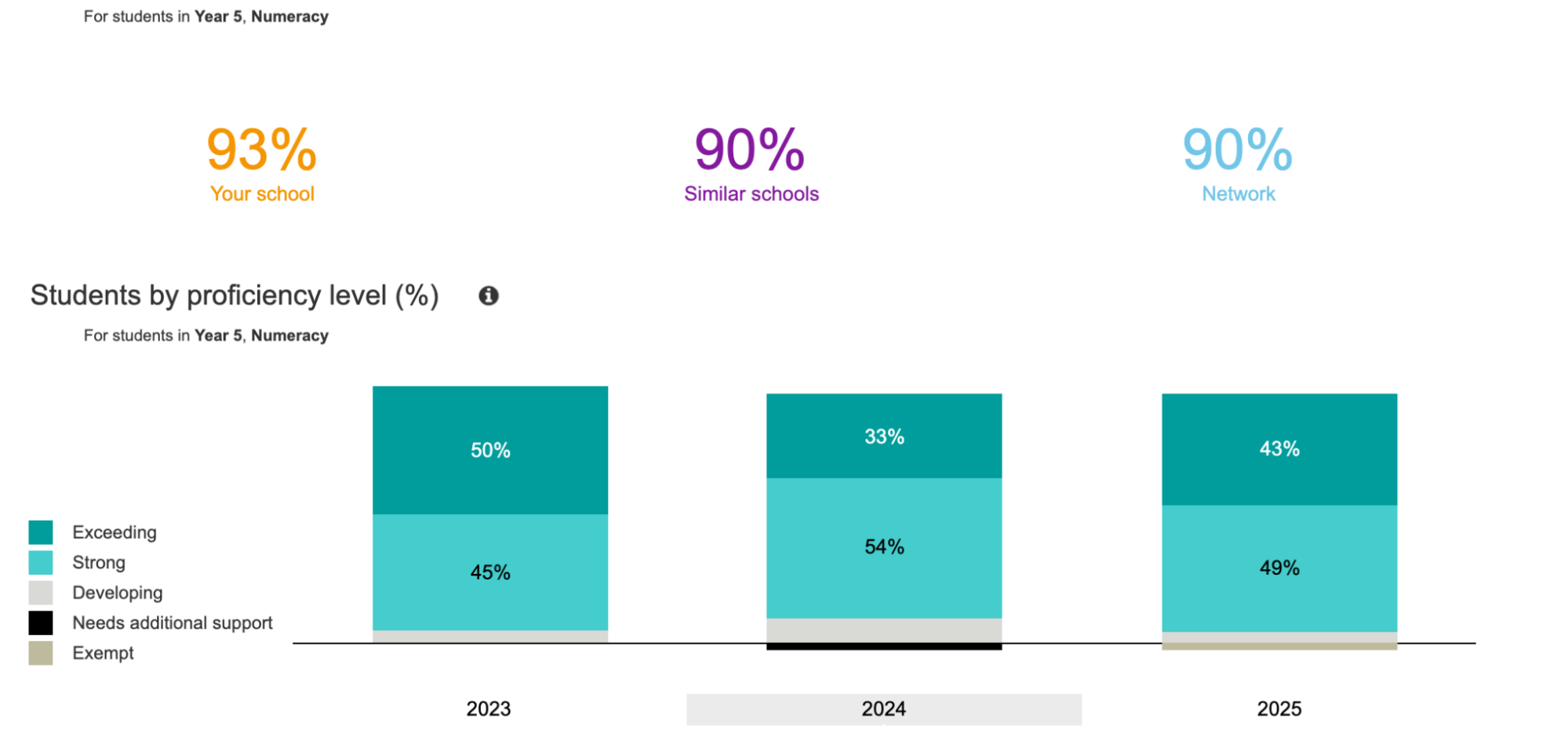
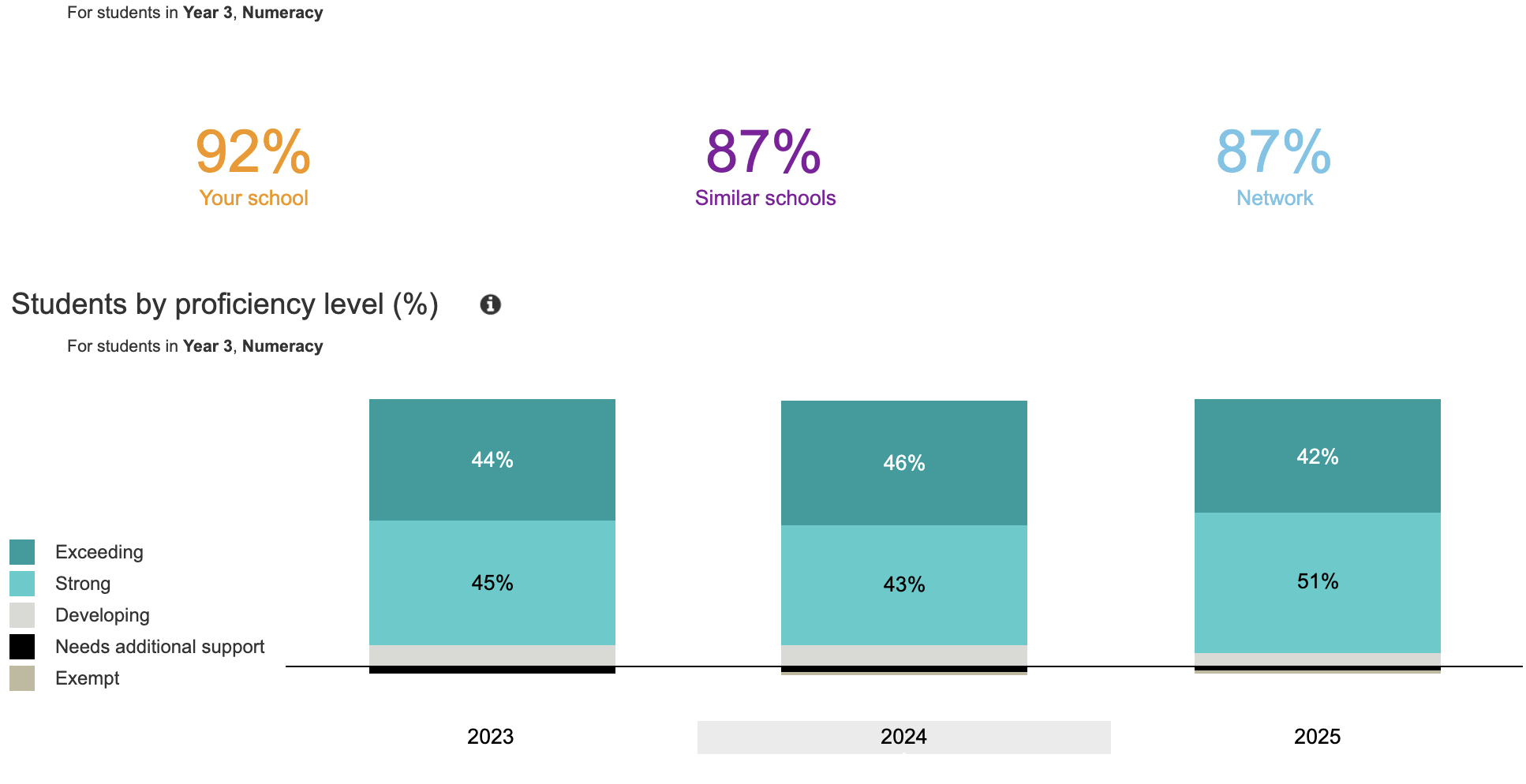
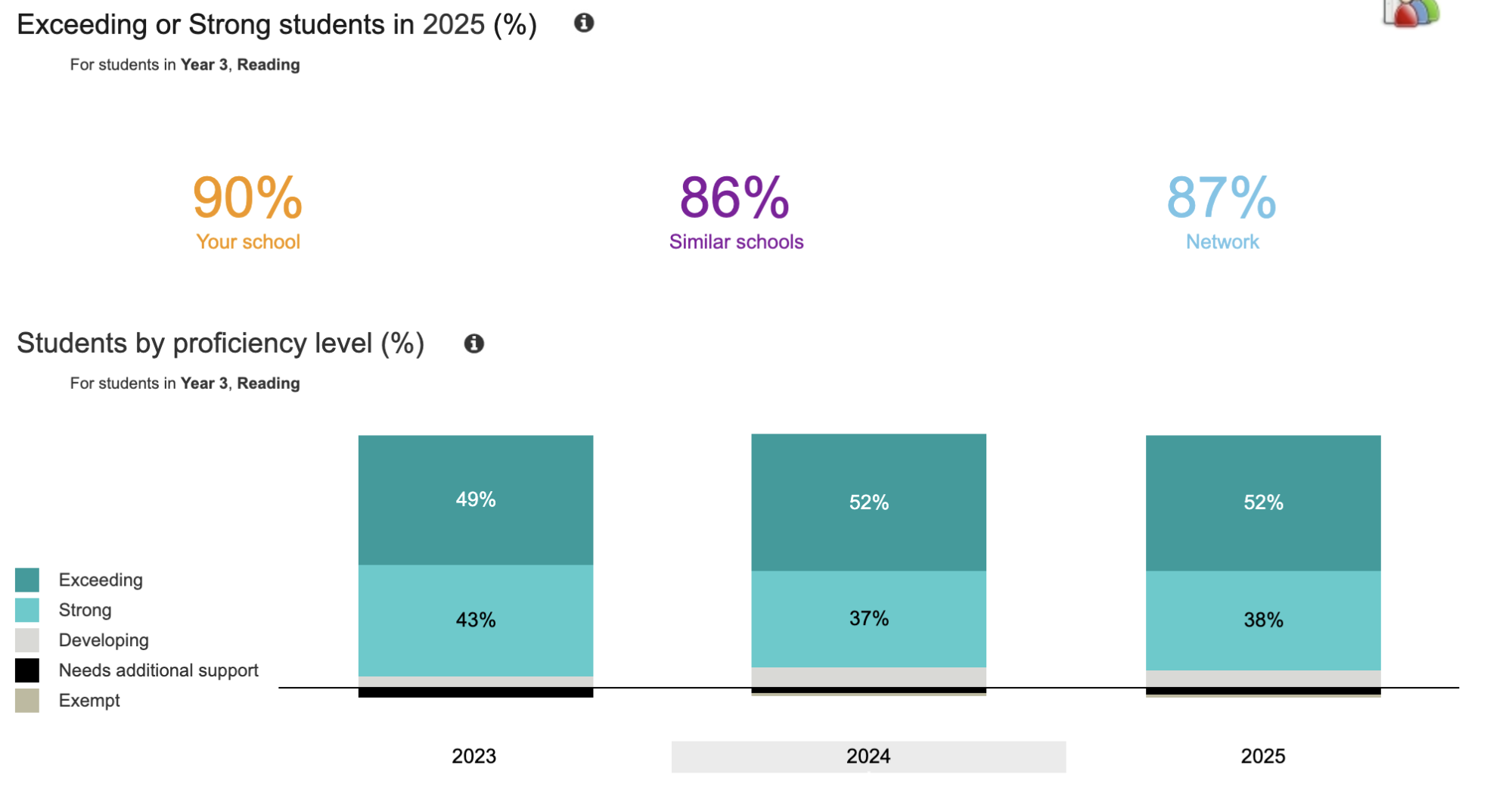
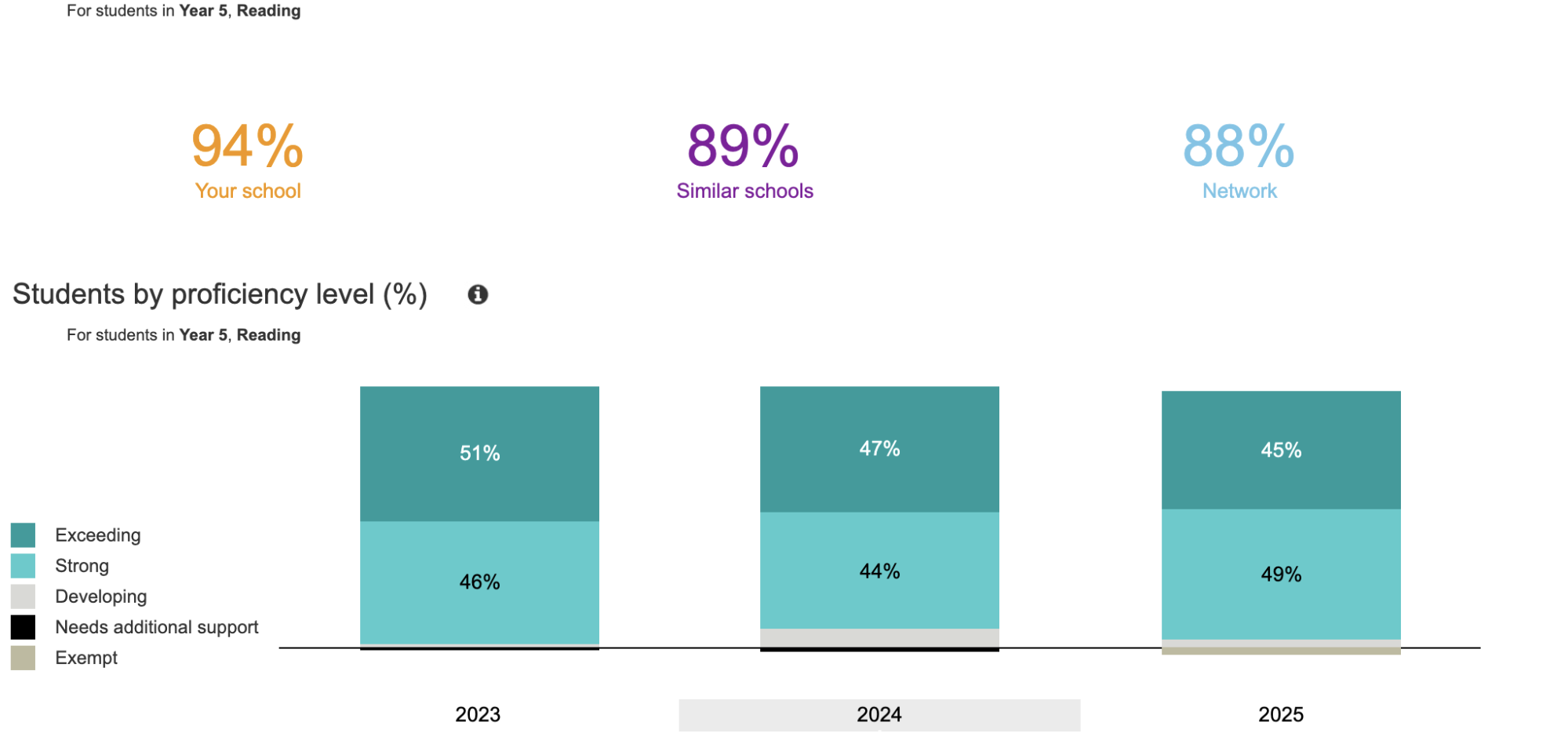
NAPLAN results are one indicator of student achievement. We focus on developing critical thinking, creativity, and problem-solving skills that extend beyond standardised testing.
At Camberwell Primary School, we prioritise the holistic wellbeing of every student, fostering a supportive and inclusive environment where they feel safe, connected, and empowered. Dedicated wellbeing sessions occur each week which are at times also guided by the needs of the cohort.
To support emotional wellbeing, we explicitly teach:
School Wide Positive Behaviour Support (SWPBS): At CPS we have implemented the School Wide Positive Behaviour Support (SWPBS) which is a proactive, evidence-based framework that creates consistent expectations and positive reinforcement across the entire school community.
- Whole-school approach to wellbeing
- Clear, consistent expectations for all students
- Positive reinforcement of expected behaviours
- Data-driven interventions for additional support
Learn about School-wide Positive Behaviour Support (vic.gov.au)
Resilience, Rights and Respectful Relationships: Designed for primary school teachers to develop students' social, emotional and positive relationship skills.
Zones of Regulation: Designed to support students to understand and manage their emotions, behaviours and sensory needs. These skills support students to improve their self-regulation and to thrive together.
URStrong Program: Designed to teach resilience, friendship skills, and emotional regulation.
- Understanding and managing emotions
- Building and maintaining friendships
- Conflict resolution strategies
- Developing resilience and coping skills
Restorative practices: When students have challenges with their interpersonal relationships, we use a Restorative Practice conversation to facilitate conflict resolution. This approach focuses on repairing harm and building relationships.
A critical element of our success when supporting students is by working in partnership with families to support the holistic development of each child.
Specialist Programs

"Ah, music…a magic beyond all we do here!" Albus Dumbledore from Harry Potter and the Philosopher's Stone.
At Camberwell Primary School we run an engaging, hands-on Performing Arts program that develops each student in the areas of music, dance and drama.
In the lower primary years, students are introduced to music by developing their singing voice – the most important, personal instrument which is key to music literacy. Students also explore beat, rhythm and the use of barred instruments through the Kodaly and Orff music methodologies.
In the middle years, students continue to develop their musical skills when introduced to the recorder. In the upper primary years, music continues to use classroom instruments focusing on composition using iPads and written music notation. Students in Year 5 and 6 also learn to play the ukulele and have the opportunity to audition for the school musical which is run biannually.
All students from Years 2 – 6 learn songs, choreography, script and dramatic elements. The production is performed over 2 nights in a theatre. Students also have the opportunity to be involved in the voluntary music clubs and events such as junior choir, middle choir, musical soirees, whole school events and assemblies.
Extra-curricular Music Electives
Camberwell Primary School also offers extra-curricular music electives in junior choir, middle choir, senior choir, Victorian State School Spectacular (every second year), piano and guitar. Participating in music electives allows students to practise and develop our values of confidence, collaboration, respect, integrity, empathy and perseverance.
- improve skills
- develop or refine technique
- practise playing or singing in a group
- develop confidence
- feel a sense of belonging
- take ownership for their learning
- explore their passions
- be creative
- perform for an audience
- develop and nurture a love for music
- HAVE FUN!

At CPS we have a full time specialist Physical Education (PE) teacher who runs our busy program of sports education, school-based events, interschool sports and students' participation in sports district and regional level.
Our sports program is as follows with specialist clinics for hockey, AFL, tennis, dance and yoga throughout the year.
- Term 1 – Fundamental Motor Skills
- Term 2 – Gymnastics, Jump Start Program Water Safety and Survival Skills
- Term 3 – Athletics
- Term 4 – Fundamental Motor Skills

The Science program at Camberwell Primary School is taught in French from Year 2 to Year 6, taught by one dedicated Science teacher on the Senior Campus. Students at Camberwell Primary School complete 60 minutes of Science per week and are assessed against the Victorian Curriculum Achievement Standards for Science.
The Science Program is organised around four key learning areas, taught in term blocks: Biology; Chemistry; Physics; and Earth and Space Science.
At Camberwell Primary School, we are proud that the Science program provides opportunities for students to develop an understanding of important science concepts and processes through a variety of investigations and experiments, following the scientific method of predicting, experimenting, observing and producing results.
The curriculum supports students in developing their scientific knowledge and its relevance in our daily life. Students acquire the skills to make informed decisions about local, national and global issues that may inspire them to follow science related careers.
Our program also integrates STEM (Science Technology Engineering and Mathematics) activities as part of lessons, in order for students to further develop their engagement with the real world. Students will experience the joy of scientific discovery and nurture their natural curiosity about the world around them.
Finally, the use of ICT is embedded throughout the teaching and learning of Science, as students enjoy coding lessons, as well as the use of iPads in relation to their lessons.

The Visual Arts program at Camberwell Primary School is informed by the Victorian Curriculum Teaching and Learning Model 2.0. It offers students rich opportunities to explore the Elements and Principles of Art through a diverse range of engaging materials such as clay, wood, paint, wool, fabric and paper.
Students work across a variety of art forms, including drawing and design (responding to a brief), collage, painting, printmaking, construction, woodwork, and threads and textiles.
Rich learning tasks are embedded at every year level to support the development of students' artistic skills and understanding. The program aims to build confidence in each child's creative ability, empowering them to use art and creative thinking as a meaningful form of personal expression.
Throughout the art-making process, students explore and discuss the Elements of Art—line, shape, colour, texture, tone and space. They learn to identify and describe these elements using appropriate terminology, building a strong foundation in arts language.
Art appreciation is an integral part of each session, with students reflecting on their own work, the work of their peers, and that of established artists. In addition to exploring a wide range of media, many units are inspired by specific artists or artistic movements. Key vocabulary is often presented in French, reinforcing language acquisition alongside visual arts learning.
At CPS, it is important to us that all students have the opportunity to experience and learn about leadership throughout their Primary School journey. Student voice and agency are an integral part of our teaching and learning approach, with students supported to reflect on the following:
- What are we learning
- Why are we learning it?
- How can we use this learning in our lives?
In addition to classroom learning, our students have a number of opportunities to build their leadership skills as they progress through the school. Some of the leadership opportunities for students include:
- Year 6 Ministers: Year 6 leaders who represent their fellow students at important school and community events. In Year 5 students stand for Minister election for a range of portfolios, which can change from year to year based on school priorities, cohort size and student voice.
- Year 6 Student Action Committees: All Year 6 students are part of a Student Action Committee, aligned with the Ministerial portfolios. Students learn to plan, implement and reflect upon actions they can take to have a positive impact upon our school and wider community.
- Student Voice Representatives (SVR): One student per class (Year 1–Year 6) is elected to be a representative for a period of two terms. SVRs gather feedback and ideas from their classmates to share back with the Year 6 Ministers and School Leadership Team.
- Year 5 Peer Mediators: All Year 4 students participate in Peer Mediation training to enable them to support their peers in the yard. Once in Year 5, students are part of a roster to act as yard mediators supporting younger students in the playground.
- Year 6 Buddies: Our Year 6 students have the opportunity to mentor Foundation students throughout their first year of school. Buddies support students through the transition into school and take part in structured activities throughout the school year.